The Hymn, the Hall, and the Hard Rule: South Asian Faith Communities and the 2026 Campaign Line
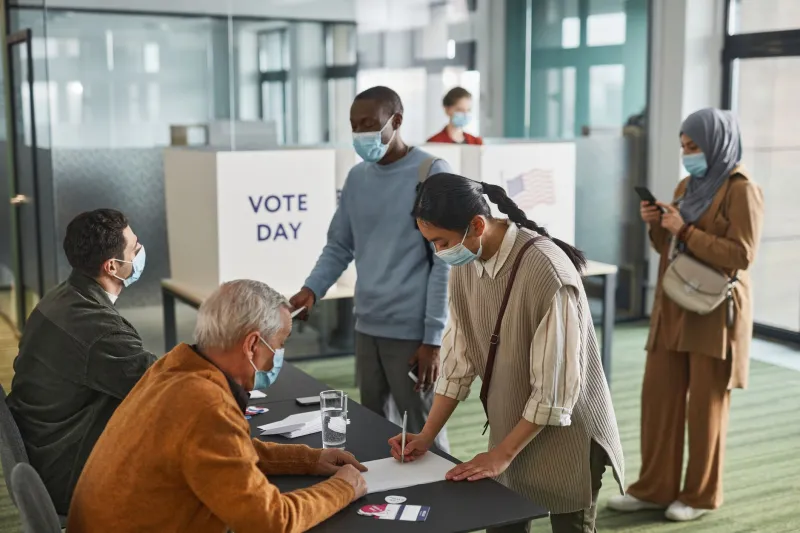
In the final weeks before the 2026 midterms, the busiest rooms in many South Asian American neighborhoods may not be party headquarters. They may be temple halls, mosque courtyards, gurdwara langar spaces, and church basements. Congregations already function as language brokers, mutual-aid networks, and informal town squares. That makes them attractive to campaigns, and it makes their leaders cautious. The reason is a provision of federal tax law that most Americans know only vaguely: the Johnson Amendment.
What the Law Actually Says
Under Section 501(c)(3) of the Internal Revenue Code, a tax-exempt charitable organization may not participate in, or intervene in, any political campaign on behalf of or in opposition to a candidate for public office. The rule is absolute in principle, though the IRS has historically enforced it sparingly and fact by fact. Churches, mosques, temples, and gurdwaras that hold 501(c)(3) status sit inside that rule. So do many of the South Asian American civic associations that share their buildings and mailing lists.
The confusion arises because the prohibition is narrower than many clergy fear and broader than many boards assume. A congregation may conduct voter registration drives, distribute nonpartisan guides, host candidate forums, and discuss public policy. It may not endorse a candidate from the pulpit, distribute a slate of preferred candidates, raise money for a campaign, or give a candidate exclusive access to its members. Issue advocacy is generally permitted, but ballot-measure activity can trigger lobbying limits and should be reviewed by counsel. The line is not a mood; it is a set of facts that the IRS examines in context.
Why Diaspora Congregations Feel the Squeeze
For South Asian American faith institutions, the Johnson Amendment intersects with pressures that are not primarily legal. Many congregations include members with mixed immigration status, pending green cards, or relatives abroad awaiting visas. A pastor or imam who appears too close to one party can create a perception — fair or not — that the institution is politically exposed. That perception can chill attendance, donations, and volunteerism. It can also invite scrutiny from donors who disagree with a leader's politics, or from members who fear that any political activity will be used against them in an immigration proceeding.
The internal question is just as delicate. South Asian American communities are not a single constituency. They span national origins, languages, religious traditions, castes, classes, and generations. A board that endorses a candidate is also making a claim about whose voice the institution represents. In swing districts from suburban Philadelphia to the Research Triangle, from the Central Valley to the Dallas suburbs, that claim can split a congregation faster than any theological dispute. The result is a distinct form of institutional caution: not silence, but a careful sorting of what belongs in the sanctuary and what belongs in the parking lot.
Where Civic Education Ends and Campaigning Begins
The practical test is whether the activity is neutral as to candidates and conducted for a civic purpose rather than a campaign purpose. A voter registration table in the lobby is generally safe if it is open to all eligible voters and does not promote a candidate or party. A candidate forum is generally safe if all qualified candidates are invited, the questions are prepared in advance, the moderator is neutral, and the event is not used to raise campaign funds. A bulletin insert that says 'Vote for Candidate X' is not safe. Neither is a religious leader's sermon that tells congregants which candidate God prefers, even if the leader speaks in personal terms while standing at the pulpit.
Local ballot fights require particular care. A congregation may have a genuine moral stake in a zoning referendum, a school board measure, or a county budget question. Issue advocacy on those matters is generally permitted, but the activity may count as lobbying and may become entangled with a candidate campaign if the same committee, consultant, or donor network is involved. The safest course is to separate civic education from electoral advocacy, document the separation, and ask counsel before endorsing or opposing a ballot measure in the institution's name.
A Checklist for Boards and Clergy
First, adopt a written policy that distinguishes permissible civic activity from prohibited campaign intervention. Second, train staff and volunteers on what they may say in their personal capacity and when they must make clear that they do not speak for the institution. Third, keep candidate appearances equal and documented. Fourth, do not use congregational lists, directories, or group chats for candidate fundraising or get-out-the-vote efforts that favor one side. Fifth, translate guidance into the languages your members actually use, because a rule understood only in English is not fully understood. Sixth, review social media practices, since an institutional account that shares a partisan post can create the same risk as a sermon.
The Johnson Amendment is rarely enforced, but rarity is not immunity. A complaint to the IRS can be costly even when it ultimately fails, and the reputational cost inside a diaspora congregation can be higher than the legal one. For South Asian American faith communities in 2026, the task is not to withdraw from civic life. It is to remain civic anchors without becoming campaign committees. That discipline protects the tax exemption, the institution's pluralism, and the trust of members who do not agree on politics but do agree on the need for a shared roof.