A Ballot You Cannot Read Is Not a Ballot: Language Access and the 2026 Midterms
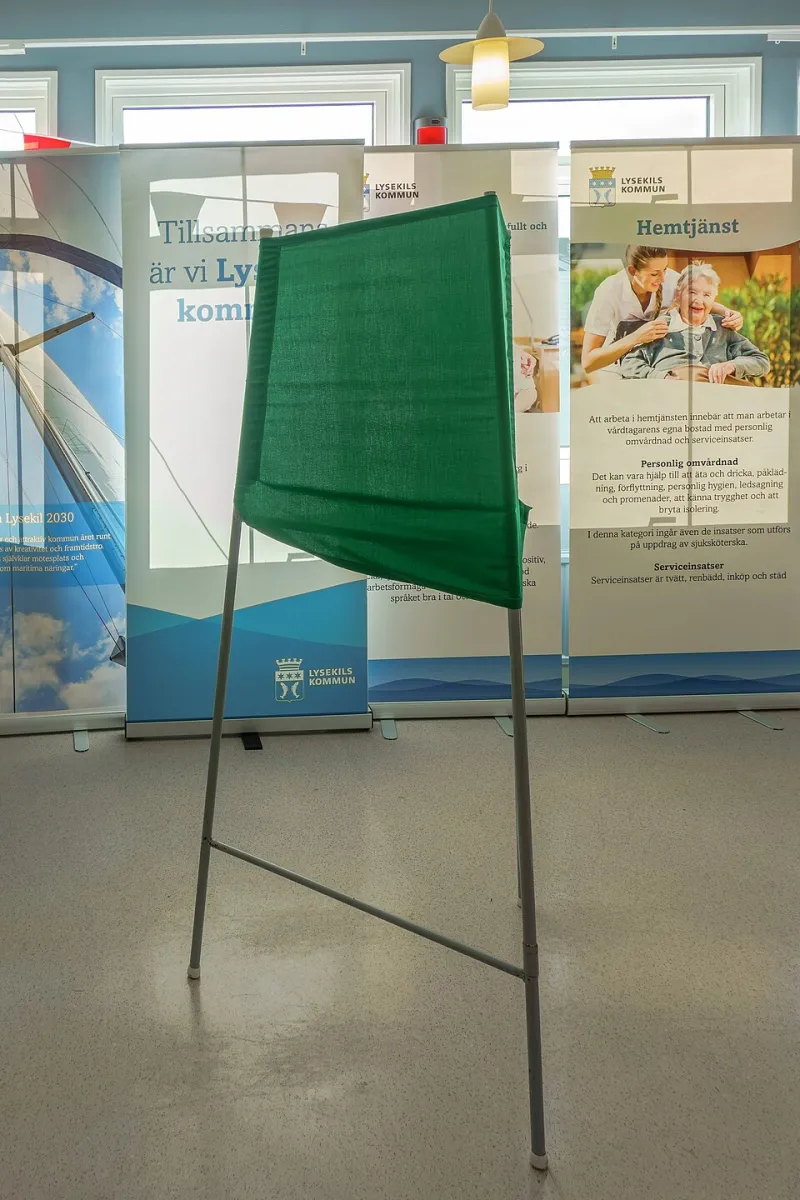
Photo: W.carter, CC BY 4.0, via Wikimedia Commons
Every election cycle produces the same photograph: a voter standing before a machine in a heavily immigrant precinct, a poll worker hovering at her shoulder, a son or daughter murmuring a translation. The caption usually calls it civic participation. The legal question underneath it is narrower and harder — whether that voter was handed, in a language she reads, an official ballot, an accurate sample, a registration form, and a clear route to correct a mistake.
For South Asian American voters, that question will be tested at scale in November 2026. The midterms will fill all 435 House seats, roughly a third of the Senate, and 36 governorships. They will also be the first midterms administered entirely under the current cycle of federal language-access determinations, in a political climate where election offices are simultaneously being asked to do more and funded to do less.
The Federal Floor Most Voters Never Encounter
Section 203 of the Voting Rights Act, added in 1975, is not discretionary and not new. It applies to a county or political subdivision when more than five percent of its voting-age citizens are limited English proficient in a single language and the local illiteracy rate exceeds the national rate — or when the raw number of such citizens exceeds 10,000, whichever is smaller. Covered jurisdictions must translate registration and voting materials, post notices, and provide oral assistance on request.
The Census Bureau issues determinations once a decade. The set published in December 2021 governs elections through 2031, so the 2026 cycle sits squarely inside it. What that means in practice is that a defined list of counties — many of them in New York, New Jersey, California, Illinois, Michigan, and Texas — must publish election materials in languages that include Bengali, Urdu, Hindi, Punjabi, and Gujarati, depending on local demographics.
The floor is real but it is low. A county with 8,800 Bengali-speaking voting-age citizens, concentrated in four precincts, may fall outside Section 203 entirely. So may a county whose LEP population is large but linguistically splintered across a dozen languages. This is why advocates rarely describe compliance as the finish line. They describe it as the minimum below which a jurisdiction is presumptively unlawful.
The Distance Between the Binder and the Booth
Translation on paper is the easy part. The harder work is the chain of custody that runs from a county clerk's office to a folding table in a school gymnasium.
Four failure points recur. First, materials that exist but are not distributed — a Bengali sample ballot posted to a county website is not the same as a Bengali sample ballot in the envelope every registered voter receives. Second, poll workers who have never been trained to find the translated materials they are legally required to hand over. Third, signage that is translated accurately but placed where no voter will see it, or posted only in a central site while the affected precincts are elsewhere. Fourth, the fail-safe systems — provisional ballots, cure procedures for rejected mail ballots, affidavit envelopes — which are frequently the last thing translated and the first thing misunderstood.
Section 208 of the same statute adds a separate protection: a voter who needs help because of blindness, disability, or an inability to read or write may bring a person of their choice into the booth, with narrow exceptions for employers and union agents. Section 208 is a powerful right that is almost never explained at the precinct level. Poll workers, trained to keep the booth clear, sometimes enforce the wrong rule.
New York City illustrates both the ambition and the gap. Bengali and Urdu are among the ten designated citywide languages under the city's language-access law, which obliges agencies to translate vital documents and staff interpretation. That is a stronger mandate than federal law imposes on most counties. It still does not guarantee that a poll site in Queens or the Bronx has a Bengali-speaking worker on a primary day when turnout is low and staffing is thinner than in November.
Why the Diaspora Frames This as a Rights Issue
Civic organizations serving South Asian communities have increasingly stopped describing translation as a service and started describing it as a threshold. The shift is deliberate, and it tracks a body of research showing that limited-English-proficient voters are more likely to have their registrations flagged, their mail ballots rejected for technical errors, and their provisional ballots discarded.
That framing has practical consequences. A courtesy can be deferred when a budget tightens. A right invites litigation, consent decrees, and monitoring. Several national civil rights organizations have used Section 203 claims — sometimes paired with Section 208 and Fourteenth Amendment arguments — to negotiate binding agreements with counties over translated materials, bilingual staffing ratios, and pre-election testing. The threat of a lawsuit has, in more than one jurisdiction, produced a better translation program than any grant could have funded.
There is also a state layer. California and Illinois impose translation obligations that exceed the federal floor, tied to local population thresholds and requiring facsimile ballots at the polling place. States without such statutes leave the entire burden to Section 203 coverage, a patchwork that produces stark differences between neighboring counties with similar populations.
The 2026 Test
The coming year brings three specific pressures. Poll-worker recruitment is the first: the election workforce skews older and turns over constantly, and bilingual recruitment from South Asian communities has historically been informal — word of mouth through temples, mosques, gurdwaras, and community associations rather than through paid county outreach. The second is money. Election offices that spent the last several cycles absorbing federal grants are now budgeting from general funds, and translation and interpretation are the line items easiest to trim because their absence is invisible until election day. The third is enforcement capacity. Federal oversight of Section 203 has always depended on complaints, and complaints require an organized community that knows where to file them.
What Would Actually Change the Number
The interventions that move turnout among LEP voters are not glamorous. Certified translations produced and reviewed by the same vendor rather than improvised by volunteers. Mandatory, paid pre-election training that requires a poll worker to physically locate the translated materials in a supply bin. Translated cure letters for mail ballots, sent with a deadline that is realistic. Bilingual staffing assigned by precinct demographics rather than by county-wide ratio. Public reporting, after each election, on provisional ballot rejection rates disaggregated by language need — a statistic most jurisdictions do not currently collect.
None of this requires new constitutional theory. Section 203 already commands much of it. The gap is between a statute that has existed for half a century and an election day that arrives every two years with the same unresolved questions.
A ballot is an instruction sheet for the exercise of power. If it reaches a voter in a language she cannot read, the state has not facilitated her vote; it has documented her exclusion. In 2026, with nearly every statewide office and the entire House on the line, that distinction is not administrative. It is the whole argument.